

Root canal treatment · The Dental Barn, Balsall Common
The tooth saved, and the pain gone.
A root canal removes the infected nerve from inside a tooth so the tooth can stay. At The Dental Barn it is £350 for a front tooth, £450 for a premolar and £550 for a molar, numb throughout, over one or two visits, with the figure for your tooth told to you before it starts.
Run by the team behind Designer Smiles in Solihull, rated 4.9 from 132 Google reviews.
In short
Does a root canal hurt?
Not during it. The tooth is numbed completely before anything starts, and once it is numb most people put the treatment at the level of a long filling: pressure and vibration, not pain. The pain a root canal is known for is the toothache before it, which the treatment ends. Afterwards the tooth is tender to bite on for a few days, and ordinary painkillers cover that.
Is it right for your tooth?
The signs you need one, and what happens if you leave it.
A root canal is for a tooth whose nerve has died or become infected, usually after deep decay, a large filling or a crack. An x-ray and a few simple tests at the examination tell your dentist whether that is what has happened; here is what usually brings people in.
The signs
- Toothache that lingers for minutes after something hot or cold, rather than fading at once.
- Pain on biting or when the tooth is tapped.
- Pain that wakes you, or throbs without anything setting it off.
- A swelling or a small spot on the gum beside the tooth, sometimes with a bad taste: an abscess draining.
- A tooth that has darkened, often after a knock years earlier, with no pain at all.
If it is left
- The infection does not heal by itself. A dead nerve cannot recover, and the space it leaves stays infected.
- Antibiotics calm it, then it returns. They reach the bone around the tooth, not the inside of it, which is why the problem comes back when the course ends.
- An abscess forms at the root, and the pain and swelling that go with it, sometimes suddenly.
- The tooth is eventually lost, and replacing it, with a bridge, a denture or an implant, costs more than saving it would have.
How it runs
Five steps, over one or two visits.
- 1
The examination
The tooth examined and x-rayed, the tests done, and the diagnosis explained on the screen. If you are in pain, the nerve can be dressed the same day (£76.60) to stop it while the full treatment is planned.
- 2
The price, in writing
The figure depends on the tooth, because a molar has three or four canals and a front tooth has one. Whether a crown will be needed afterwards is told to you now, not later.
- 3
Numb, then clean
The tooth is anaesthetised and isolated with a thin rubber sheet to keep it dry. The infected nerve is removed and the canals are cleaned, shaped and disinfected.
- 4
Sealed
The canals are filled and sealed so nothing can get back in, and the tooth is closed with a filling. Back teeth usually need a crown afterwards to stop them cracking; front teeth often do not.
- 5
Checked
The tooth is reviewed at your check-ups and x-rayed when due, to see the bone around the root healing.

What it is like
A long filling, then a few tender days.
Allow an hour or so for each visit; molars often take two. You lie back with the tooth numb and a small rubber sheet over it, and the dentist works inside the tooth with fine instruments. It is dull rather than dramatic. Music or a podcast in your ears helps, and you can raise a hand to stop at any point.
Afterwards the numbness wears off over a couple of hours and the tooth is tender to bite on for a few days, occasionally a week. Ordinary painkillers from the packet cover it, you eat on the other side, and you go to work the next day. Anyone who dreads dentistry can have sedation for the treatment at £350 a session.
What it costs
Priced by the tooth.
A front tooth has one canal, a premolar one or two, a molar three or four, and the price follows the work. On the NHS a root canal is a Band 2 course of treatment, or Band 3 if the crown is done in the same course; here the same treatment is private, priced per tooth, and the crown that a back tooth usually needs afterwards is priced at the NHS Band 3 figure. If you are entitled to free NHS treatment, an NHS practice will cost you less than we do.
NHS figures are England’s band charges as nhs.uk publishes them; ours are from The Dental Barn fee guide, September 2026.
Save it or take it out
Root canal against extraction, set side by side.
The question people ask is whether it is worth paying to save the tooth when taking it out is cheaper. Here is the comparison over the years, not the week.
| What happens | Visits | Price here | Ten years on | |
|---|---|---|---|---|
| Root canal | The nerve removed, the canals cleaned and sealed; the tooth stays and is crowned if it is a back tooth | One or two, plus the crown | £350 to £550, plus a crown from £332.10 where needed | Your own tooth, biting as before; most root-treated teeth last many years |
| Extraction | The tooth taken out; the gap closed later with a bridge, a denture or an implant, or left | One, then the replacement’s visits | From £76.60, then a bridge from £400 a unit, a denture from £332.10 or an implant from £1,700 | A replacement to look after, or a gap that lets the neighbours drift |
| Leaving it | The infection stays; antibiotics calm it for a while | Emergency visits as it flares | An emergency appointment each time, then the tooth is lost anyway | The tooth gone, and the bone around it damaged by the years of infection |
Where a tooth is too broken down to be worth saving, your dentist says so, and extraction is the honest answer. The x-ray at the examination decides it.


Who does it
The practice’s dentists, and a specialist when the tooth needs one.
Dr William Tarn-Chapman · Dr Sarah Lynn · Dr Amelia Reed · Dr Aadam Binamin, GDC 265535Root canals here are done by the practice’s own dentists: Dr William Tarn-Chapman, whose restorative work in a busy Birmingham NHS practice and then in private practice in Australia is where his interest lies; Dr Sarah Lynn and Dr Amelia Reed, both with further qualifications in restorative dentistry. A curved, calcified or previously treated tooth is seen by a dentist with a special interest in root canal treatment, with a consultation at £50 and the treatment priced to the case, because the honest answer to a hard canal is the person who does hard canals every week.
Meet the teamQuestions
Asked before people book.
How much does a root canal cost in the UK?
On the NHS a root canal is a Band 2 course of treatment, £76.60, or Band 3 at £332.10 if a crown is done in the same course. Privately it is priced by the tooth: at The Dental Barn £350 for a front tooth, £450 for a premolar and £550 for a molar, with a crown from £332.10 where the tooth needs one afterwards.
How much does a root canal hurt, on a scale of one to ten?
During the treatment, with the tooth numb, most people would say one or two: pressure and vibration. The toothache before it is the part that scores high, and the treatment is what ends it. For a few days afterwards the tooth is tender to bite on, at the level a painkiller from the packet deals with.
What are the signs I need a root canal?
Toothache that lingers after hot or cold, pain on biting, pain that wakes you or throbs on its own, a swelling or spot on the gum beside the tooth, or a tooth that has darkened. None of these proves it; an x-ray and a couple of simple tests at the examination do.
What happens if I avoid a root canal?
The infection inside the tooth does not heal on its own and antibiotics only reach the bone around it, so the pain returns when the course ends. Left long enough, an abscess forms, the bone around the root is damaged, and the tooth is lost. Taking it out is a legitimate choice; leaving it is not one.
Is it worth paying for a root canal rather than having the tooth out?
Usually, yes. Extraction is cheaper on the day, from £76.60, but a gap then needs a bridge, a denture or an implant, each of which costs more than the root canal, or it stays a gap and the neighbouring teeth drift into it. A root canal keeps your own tooth, which nothing replaces exactly.
Is a private root canal better than an NHS one?
It is the same procedure and the same standards. What private buys is time, the choice of who does it, a specialist for the difficult tooth, and the appointment when you need it. The NHS price is lower, and if you are entitled to free NHS treatment, an NHS practice is the cheaper route.
How long does a root canal take?
About an hour for a front tooth, often two visits for a molar with its three or four canals. If the tooth is infected and swollen, the first visit may be a dressing to settle it and the full treatment follows a week or two later.
How many days off do I need?
None, usually. You leave numb, the numbness wears off over a couple of hours, and you work the next day. The tooth is tender to bite on for a few days; you eat on the other side.
Do I need a crown after a root canal?
Back teeth usually do, because a root-treated molar is more brittle and a crown stops it cracking; front teeth often need only a filling. Your dentist tells you which before the treatment starts, with the crown’s price, from £332.10, beside it.
Can a root canal fail?
Sometimes. A canal that could not be found or fully cleaned, a crack, or a leaking filling can let infection back in, months or years later. Most such teeth can be re-treated, which is work for a dentist with a special interest in root canals; the consultation is £50 and the treatment is priced to the case.
Where are you, and how do I book?
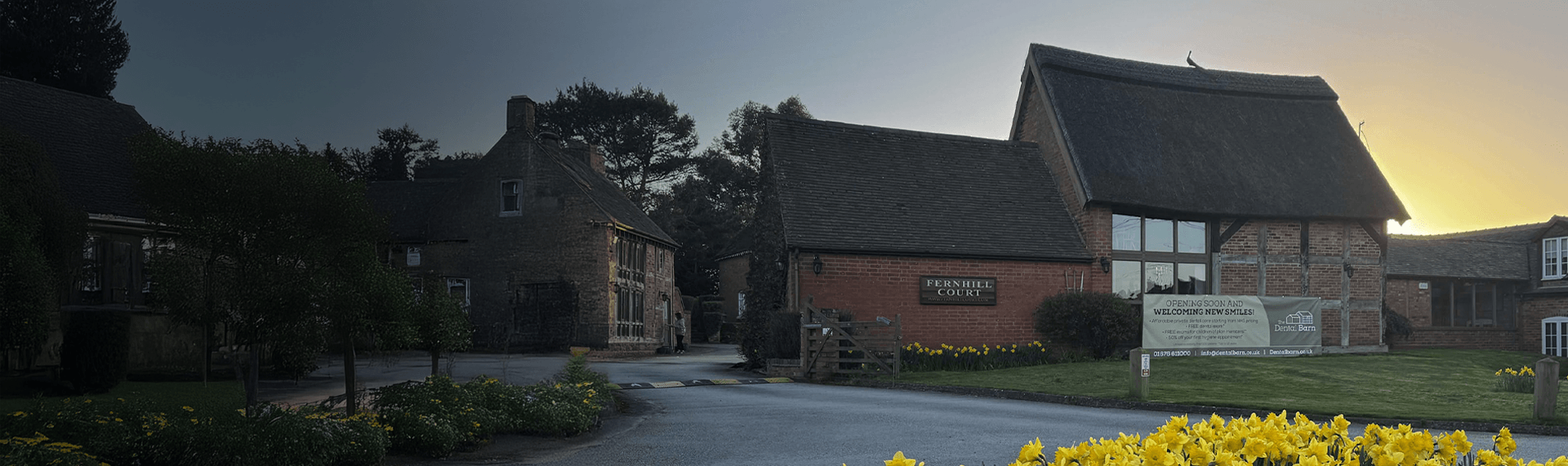
The Barn, 4 Fernhill Court, Balsall Street East, Balsall Common, CV7 7FR. Book online, call 01676 611000, or message us on WhatsApp. If you are in pain now, ring early in the day: the emergency appointment is £27.90.
Read before you decide
The questions behind the price, answered.
Keep the tooth. Lose the toothache.
£350 to £550 by the tooth, numb throughout, the figure told to you first.
Fernhill Court, 4 Balsall Street East, Balsall Common CV7 7FR · [email protected]

Contact Us
Fernhill Court
4 Balsall Street East
Balsall Common
CV7 7FR
